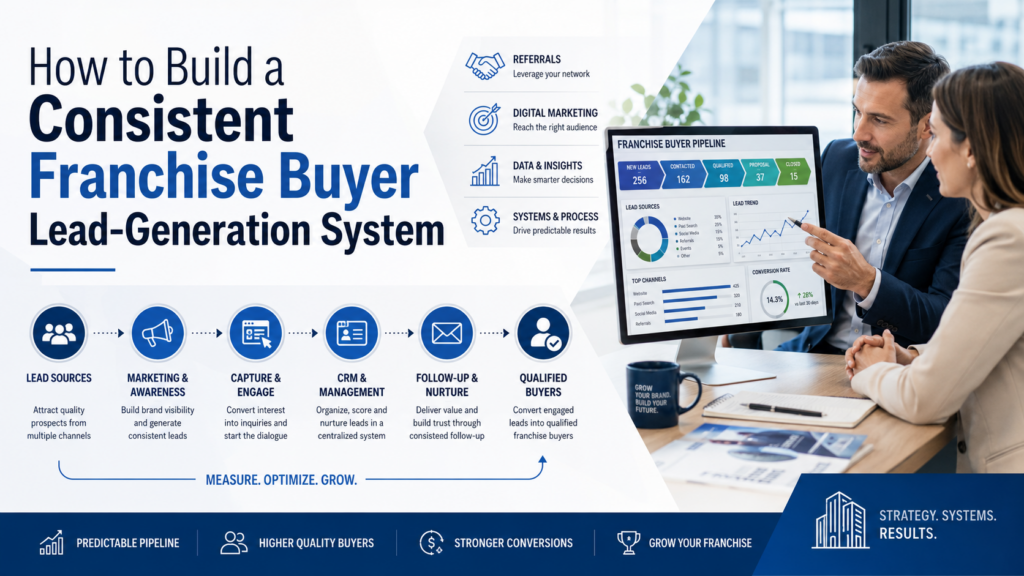
This article is geared toward Franchise Brokers, Consultants & Coaches to discuss How to Build a Consistent Franchise Buyer Lead-Generation System.
Many Franchise Consultants enter the business believing that success will come from finding a few qualified candidates, matching them with the right Franchise concepts, and earning commissions when those candidates invest.
While that is technically how the business works, it leaves out the most difficult part:
Consistently finding qualified Franchise buyers.
Most Franchise brokers do not have a candidate-matching problem. They have a lead-generation problem.
They may receive occasional referrals, purchase internet leads, attend networking events, post sporadically on social media, or reconnect with people from their personal network. These activities can produce results, but they rarely create a predictable pipeline.
One month may be filled with candidate calls. The next month may be nearly empty.
To build a sustainable Franchise brokerage, you need more than isolated marketing activities. You need a repeatable lead-generation system that consistently moves people from awareness to conversation to qualification.
Why Most Franchise Brokers Struggle With Lead Generation
The typical Franchise broker relies too heavily on one or two lead sources.
For example, a broker may depend on:
- Leads supplied by a Franchise broker network
- Purchased internet leads
- Referrals from friends and former colleagues
- LinkedIn outreach
- Local networking groups
- Occasional social media posts
Each of these methods can work. The problem is that no single source is completely reliable.
Purchased leads can become more expensive. Referral activity can slow down. Social media algorithms can change. Networking groups may produce plenty of conversations but very few qualified candidates.
A dependable lead-generation system should have multiple channels working together.
The goal is not to be everywhere. The goal is to build a small number of repeatable lead sources that can be measured, improved, and scaled.
Step 1: Define Your Ideal Franchise Candidate
Before generating more leads, you must determine whom you want to attract.
“Anyone interested in buying a Franchise” is too broad.
A better candidate profile may include specific characteristics such as:
- Corporate professionals considering career alternatives
- Executives affected by layoffs or restructuring
- Existing business owners looking to diversify
- Veterans transitioning into business ownership
- Real estate investors seeking another income stream
- High-income professionals interested in semi-absentee ownership
- Couples looking to build a family business
- Entrepreneurs with $100,000 or more in available capital
Your marketing becomes more effective when it speaks directly to a particular situation.
For example, a corporate executive is probably not searching for “Franchise consulting.” That person may be searching for:
- Alternatives to corporate employment
- How to replace a six-figure salary
- Best businesses for executives
- Semi-absentee business opportunities
- How to use retirement funds to buy a business
- Franchise ownership after a layoff
Your lead-generation message should begin with the candidate’s problem—not with the fact that you are a Franchise broker.
Step 2: Create a Clear Entry-Point Offer
Most potential Franchise buyers are not ready to immediately schedule a call about specific brands.
They may still be trying to understand whether business ownership is right for them.
Instead of asking prospects to make a major commitment, give them an easy first step.
This could include:
- A Franchise buyer readiness assessment
- A business ownership personality profile
- A Franchise investment guide
- A list of common Franchise-buying mistakes
- A webinar about replacing corporate income through business ownership
- A guide to funding a Franchise
- A Franchise candidate evaluation session
- A semi-absentee ownership checklist
The purpose of the offer is not merely to collect an email address. It should help the prospect answer an important question or make progress toward a decision.
A strong entry-point offer allows you to begin the relationship before the prospect is ready to discuss individual Franchise concepts.
Step 3: Build Multiple Lead Sources
A consistent Franchise buyer pipeline should not depend on a single marketing channel.
A strong system may include four primary categories.
1. Referral Partnerships
Referral partners can become one of the most valuable lead sources for a Franchise broker.
Potential partners include:
- Business brokers
- Financial advisors
- CPAs
- Business attorneys
- Commercial lenders
- SBA lenders
- Career transition coaches
- Executive recruiters
- Outplacement firms
- Real estate professionals
- Insurance professionals
- Payroll and human resources consultants
These professionals frequently meet people who may be considering business ownership.
However, simply telling someone, “Send me anyone who wants to buy a Franchise,” is usually not enough.
Referral partners need to understand:
- The type of candidate you help
- The problems those candidates are experiencing
- The signs that someone may be open to Franchise ownership
- What happens after they make an introduction
- How you will protect their relationship with the prospect
Create a short referral-partner presentation and a simple introduction process.
2. Educational Content
Educational content allows potential candidates to discover and evaluate you before speaking with you.
Useful content topics may include:
- Franchise ownership versus starting an independent business
- How much money is needed to buy a Franchise
- The advantages and disadvantages of semi-absentee ownership
- How Franchise funding works
- Questions to ask a franchisor
- Understanding Item 19 of the Franchise Disclosure Document
- How long it takes to open a Franchise
- Franchise ownership after a corporate career
- How to involve a spouse in the Franchise decision
You do not need to become a full-time content creator.
One strong weekly article or video can be repurposed into:
- LinkedIn posts
- Facebook posts
- Short videos
- Email newsletters
- Webinar topics
- Downloadable guides
- Follow-up messages
Consistency matters more than volume.
3. Direct Outreach
Direct outreach can help you create conversations instead of waiting for prospects to find you.
The strongest outreach is targeted and relevant.
You might reach out to:
- Executives who recently changed employment status
- Business owners who recently sold a company
- Professionals approaching retirement
- People engaging with business ownership content
- Members of local executive networking groups
- Veterans transitioning from military service
- Former candidates who paused their search
Avoid opening with a Franchise sales pitch.
A better message starts with the prospect’s circumstances and offers a useful conversation.
For example:
“I work with experienced professionals who are exploring alternatives to traditional employment, including Franchise and business ownership. I would be happy to share a few resources that explain the process if that is something you have considered.”
The goal of the first message is to start a conversation, not close a deal.
4. Database Reactivation
Many brokers focus almost entirely on generating new leads while ignoring the people already in their database.
Past candidates may have paused because of:
- Financing
- Timing
- Family concerns
- Employment changes
- Geographic limitations
- Fear or uncertainty
- A lack of suitable Franchise options
Circumstances change.
A candidate who was not ready 12 months ago may be ready today.
Create a reactivation campaign that includes:
- A personal check-in email
- A short text message
- A business ownership update
- A new assessment or guide
- An invitation to a webinar
- A request to revisit their goals
- New concepts that match their original criteria
Your existing database may be one of your least expensive and most productive sources of future business.
Step 4: Create a Follow-Up Process
Generating a lead is only the beginning.
Most prospective Franchise buyers will not schedule a consultation immediately. They may need weeks or months before taking the next step.
Without a follow-up system, many qualified opportunities will be lost.
A basic follow-up sequence may include:
Immediately
Send the requested guide, assessment, or resource and explain the next logical step.
Day 1
Send a personal introduction and ask one simple question about the prospect’s goals.
Day 3
Share a helpful article or video related to their situation.
Day 7
Invite them to schedule an introductory business ownership conversation.
Day 14
Address a common concern, such as funding, risk, time commitment, or selecting the right industry.
Day 30
Share a candidate success story or Franchise ownership case study.
Ongoing
Continue sending useful educational content at least once or twice per month.
Automation can support this process, but the communication should still feel personal.
Your CRM should tell you:
- Where each candidate originated
- What resource they requested
- Whether they scheduled a call
- Their current stage
- When they were last contacted
- What action should happen next
No qualified lead should disappear simply because you forgot to follow up.
Step 5: Measure the Right Numbers
You cannot improve a lead-generation system if you do not measure it.
At minimum, track:
- New leads generated
- Lead source
- Cost per lead
- Consultation appointments scheduled
- Appointment attendance rate
- Qualified candidates
- Candidates presented with Franchise concepts
- Franchise validation activity
- Applications completed
- Franchise agreements signed
- Revenue generated by lead source
Do not evaluate a marketing source based only on how many leads it produces.
One source may generate 100 low-quality leads. Another may generate 10 highly qualified candidates.
The most important question is:
Which activities produce candidates who move through the Franchise investigation process and ultimately invest?
Step 6: Establish a Weekly Lead-Generation Routine
Lead generation should be a scheduled business activity, not something you do only when your pipeline is empty.
A Franchise broker’s weekly routine could include:
- Contacting five potential referral partners
- Following up with existing referral partners
- Publishing one educational article or video
- Sending one email to the candidate database
- Reconnecting with five older candidates
- Conducting targeted LinkedIn outreach
- Reviewing pipeline activity
- Measuring lead-source performance
- Scheduling next steps for every active candidate
Small, consistent actions produce better results than occasional bursts of marketing.
When lead generation becomes part of your weekly operating system, the business becomes more predictable.
The Goal: A Pipeline You Can Control
A successful Franchise brokerage should not depend entirely on luck, personal referrals, or leads supplied by someone else.
The broker should be able to clearly explain:
- Who the ideal candidate is
- How that candidate discovers the brokerage
- What offer encourages the person to respond
- How the lead is followed up with
- How the candidate is qualified
- How each lead source is measured
- What activities happen every week
That is the difference between doing occasional Franchise deals and building a sustainable Franchise brokerage.
A dependable lead-generation system does not eliminate the need for relationships, trust, or personal selling. It creates more opportunities to use those skills.
When the right audience, message, marketing channels, follow-up process, and performance metrics work together, lead generation becomes less reactive and far more predictable.
Want to talk Franchising? Use this link to schedule a call with me.
I LOVE talking about Franchise Development, Franchise Sales, Franchise Consulting, pretty much anything Franchising!